
We just launched PenTest.WS v2.3, and it’s a big one, especially if your red team ops go beyond just scanning ports and popping shells. With this release, we’re giving Pro Tier users new tools to track and understand the people behind the infrastructure. Because sometimes the weakest link isn’t a host, it’s a human.
People Hacking
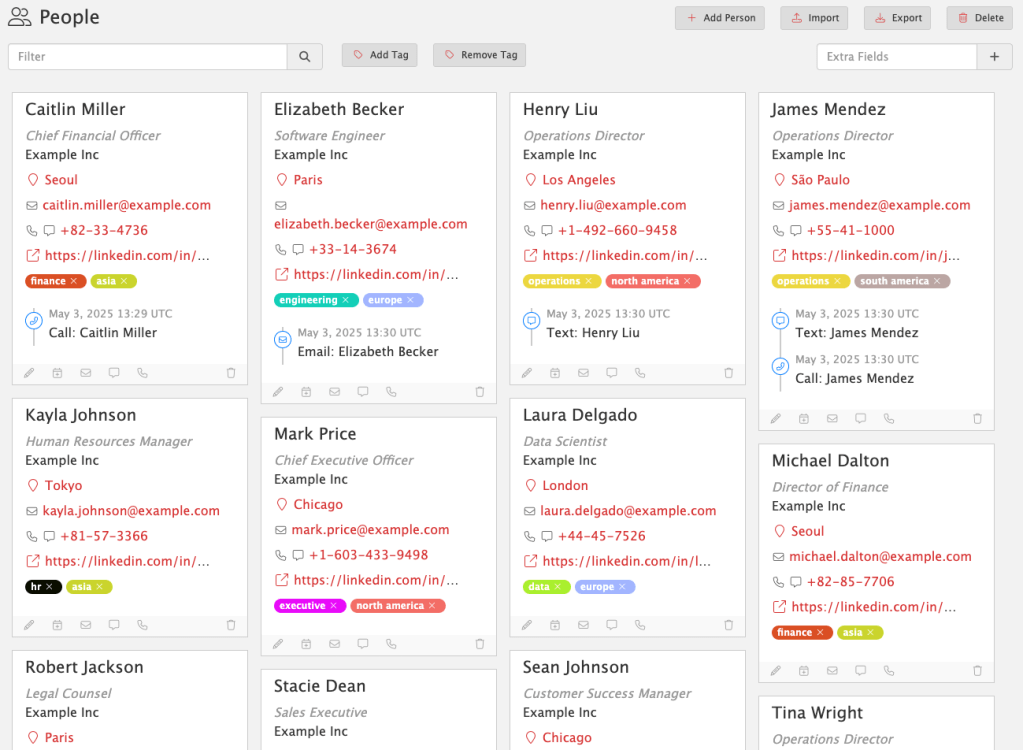
Social engineering is more than just an attack vector, it’s a workflow. And now you can track it like one.
People Hacking gives you a dedicated space to track social engineering targets, tactics, and outcomes. Each person is a first-class object, complete with contact details, tags, profile URLs, locations, and communication history.
People Hacking lets you:
- Log phone calls, phishing attempts, texts, or in-person interactions
- Assign custom tags to track roles, regions, risk levels, or anything else
- Link SE engagements directly to findings as supporting evidence
- Capture everything in one searchable, structured view
No more scattered notes or one-off spreadsheets. With People Hacking, social engineering becomes a trackable, repeatable part of your red team ops.
For more information, visit the docs:
https://docs.pentest.ws/people-and-events/people-hacking
Available now in Pro Tier. Because real-world attackers don’t stop at the firewall, and neither should you.
Events Timeline
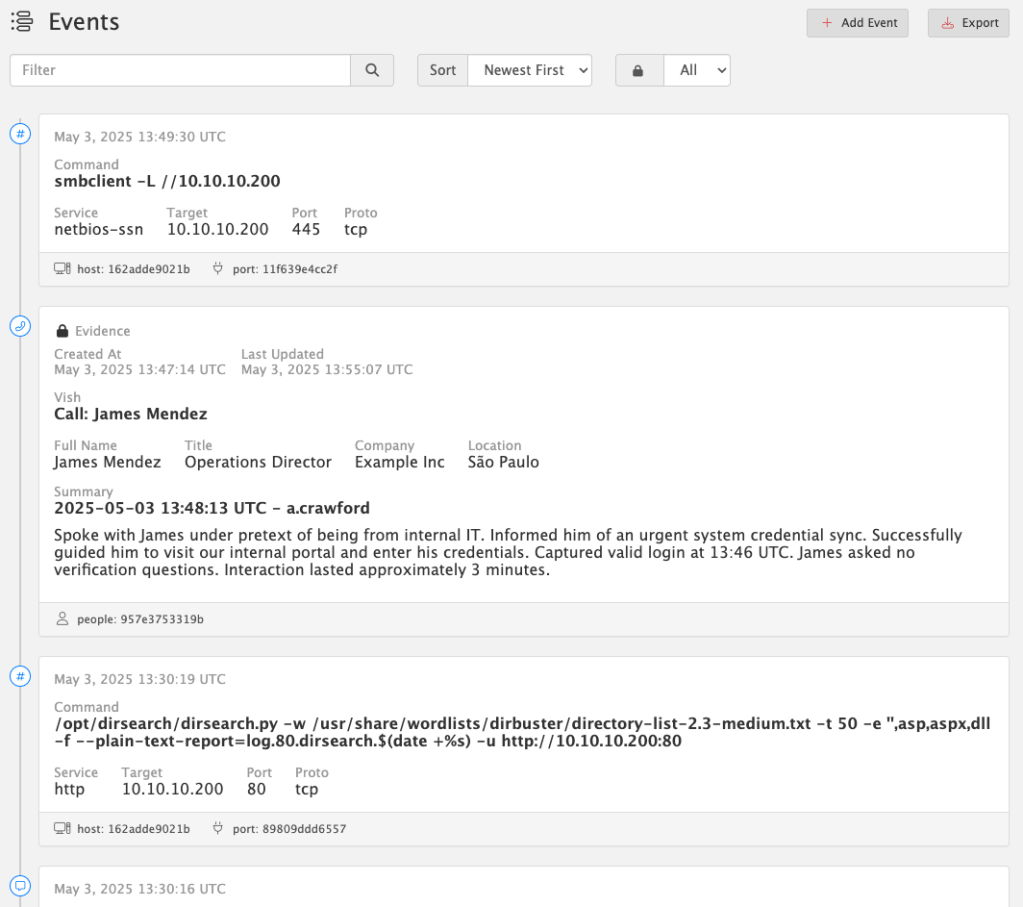
Every op leaves behind a trail of actions, commands, and interactions. Now you can see them all – organized, timestamped, and linked – in the new Events Timeline.
The Events Timeline tracks everything you do across:
- Hosts
- Services
- People
- Detections
- Social Engineering interactions
Quickly log any event with built-in shortcuts – like when you vish a target, phish credentials, or run a tool. Just click “Add Event” to capture everything: summary, metadata, related objects, and context.
Better yet: every time you launch a command from the Service Command Library (via Copy Command in Hosts or Services), an event is automatically created and linked to the relevant host or port. No extra clicks, no forgotten steps.
All events are UTC timestamped to simplify cross-system correlation.
🔒 Evidence Locking
When an event becomes critical to your story, tag it as Evidence. From that moment on, it’s immutable – locked from edits or deletion – to preserve the integrity of your timeline and findings. This ensures you have a defensible, auditable chain of actions tied directly to your report.
For more information, visit the docs:
https://docs.pentest.ws/people-and-events/events-timeline
Available now in Pro Tier. Build a real timeline. Back it with real evidence.
Report Engine Update
Breaking Change: Report Template Syntax Update
PenTest.WS now uses {{ and }} as the default delimiters for report template commands, replacing the previous { and } syntax.

This update improves compatibility with more complex templating scenarios.

If you maintain custom report templates, you’ll need to update any placeholders like {engagement.name} to {{engagement.name}} to ensure they continue rendering correctly.

Until then, use the "Generate Legacy Report" button to generate reports using the old syntax.
We’ve officially sunset support for LibreOffice in the main report engine. You’ll still find “Generate Legacy Report” available for now, but moving forward, all reports are optimized for Microsoft Word (.docx).
This change was made to ensure full compatibility with embedded HTML content – like rich text from summaries, notes, and evidence fields – which LibreOffice often struggles to handle cleanly. Over the years, these issues have created friction for users and undermined the reliability of the reporting experience.
Our focus is on stability and precision, especially for users generating formal deliverables. Supporting LibreOffice was a well-intentioned effort to reduce cost barriers, but ultimately, Word is the only platform that consistently handles the full range of features we support.
For an updated Report Template which includes People & Events:
https://docs.pentest.ws/clients-and-reporting/reporting-templates
This update applies to all tiers: Free, Hobby, and Pro.
Defenders, Meet Your New Ally

PenTest.WS is built for red teams. ChallengeWord is built for blue.
Social engineering remains one of the most effective attack vectors. While technical defenses are essential, empowering your team to verify identities in real time is just as critical.
ChallengeWord introduces a human-centric layer of security by providing your team with a rotating, shared secret word, on-demand. It gives employees a discreet, low-friction way to confirm the legitimacy of unexpected calls, texts, or in-person interactions, without confrontation.
By integrating ChallengeWord into your security protocol, you equip your team to:
- Quickly identify impersonators attempting to breach your organization.
- Enhance existing training with a practical, real-time verification tool.
- Reduce the risk of falling victim to vishing, smishing, and other social engineering tactics.
It’s a straightforward solution to a complex problem, designed to bolster your organization’s human firewall.

 PenTest Workshop News